The guide · PDF, 5 pages
Cover ratios — DSCR, LLCR and PLCR
What each one asks, worked on a 100 MW solar plant: how lenders size, sculpt and test a loan with them, and four quiet errors that flatter an LLCR.
The cash a project’s lenders are paid from — what goes into it, how it is worked out, and where models get it wrong.
By Mayank Jain ·
Cover ratios — DSCR, LLCR and PLCR — 5 pages, free to read.
What it is
CFADS (cash flow available for debt service) is the cash a project has left in a period after its operating costs, the tax it pays, its maintenance capex and any change in working capital — the cash its lenders’ interest and principal are paid from.
It is cash, not profit, and the loan agreement defines it. EBITDA leaves out the tax, the maintenance and the working capital.
CFADS sits near the top of the cash flow waterfall. Each period it is paid out in the same order:
Every cover ratio starts from it. The DSCR, the LLCR and the PLCR set CFADS against the debt, and a loan is sized and sculpted on it.
How it is worked out
CFADS = revenue − operating costs − tax paid − maintenance capex ± working capital
DSCR = CFADS of the period ÷ the interest and principal due in it
The tax is the tax paid in the period. The working capital adds cash when the money owed to the project falls, and takes it away when it grows.
The plant is the made-up one in the DSCR guide: USD 60 mn, 25 years after COD, and senior debt of USD 42.0 mn at 6% all-in over 18 years, sculpted to a 1.30x DSCR. Its first year, in USD mn, split the way we chose for this page:
The debt service that year is 5.40 ÷ 1.30 = 4.15: interest of 2.52 and principal of 1.63. The DSCR is 5.40 ÷ 4.15 = 1.30x. Read EBITDA in its place and the same year shows 6.1 ÷ 4.15 = 1.47x — cover that is not there.
After year 1 the CFADS falls 1% a year: 4.55 in year 18, the last repayment, and 4.24 in year 25. Discounted at the loan’s 6%, the CFADS to the last repayment is worth USD 54.6 mn — 1.30 times the debt.
Some loan agreements also take the agency fee, a reserve facility’s fees and the cost of a letter of credit off before CFADS. Interest earned on a cash reserve is income: it is taxed, and it is not CFADS unless the agreement says so. Read the definition first, then build.
What to watch for
None of these raises an error flag, and the balance sheet still balances. Each one makes the cover look better than it is.
The CFADS is the waterfall’s line — not EBITDA, and not the cash after the reserves. The cure is to rebuild one year by hand, from the revenue down, and match it to the model’s CFADS line.
Read and watch
The guide · PDF, 5 pages
What each one asks, worked on a 100 MW solar plant: how lenders size, sculpt and test a loan with them, and four quiet errors that flatter an LLCR.
Also in the Knowledge Center · PDF, 25 pages
Everything about project debt — explained with one salary, one EMI and a very patient bank: DSCR, gearing, sizing and sculpting.
Guide · on this site
The three cover ratios lenders read a project by: what each asks, how it is worked out and four quiet errors.
Guide · on this site
Repayments that follow the cash: the formula, a year-by-year example, and sculpted against level.
Guide · on this site
Six months of debt service set aside: how it moves, what it costs against an LC or a DSRF, and the errors.
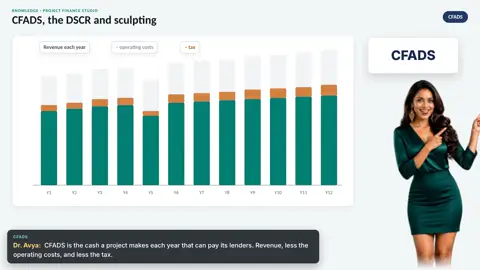
Film · 0:58
Dr. Avya draws CFADS, the debt service at a target DSCR, sculpting, the debt it supports — and what a level repayment does to the cover.
No. EBITDA is a profit line. CFADS is cash: EBITDA less the tax paid and the maintenance capex, adjusted for working capital. In the guide’s example year 1 has EBITDA of USD 6.1 mn and CFADS of 5.4 mn — a DSCR of 1.47x read on EBITDA, against a true 1.30x.
After. CFADS takes off the tax the project pays in the period, because that cash cannot go to the lenders.
The loan agreement. It defines CFADS, and the model follows the definition — including whether fees, reserve releases or the interest earned on a reserve are in or out.
No. The reserve sits below the debt service in the waterfall: it is topped up from the cash left after the lenders are paid, and it pays the gap when CFADS falls short. Count a reserve once, as the loan agreement says — never in CFADS and in the LLCR at the same time.
To test and size the loan. The DSCR sets each period’s CFADS against that period’s debt service; the LLCR and the PLCR set its present value against the debt; and a sculpted loan’s debt service is the CFADS divided by the target DSCR.
In the Studio
In Project Finance Studio the cash flow has a line of its own, Cash available for debt service (CFADS), and the facility fees can be taken off it rather than put in the debt service. Where the debt is sized on part of the revenue only, a second line shows the CFADS the debt is sized on, while the DSCR the lenders test uses all of it. Trace shows every number behind them, and the Excel workbook has the same lines as live formulas.